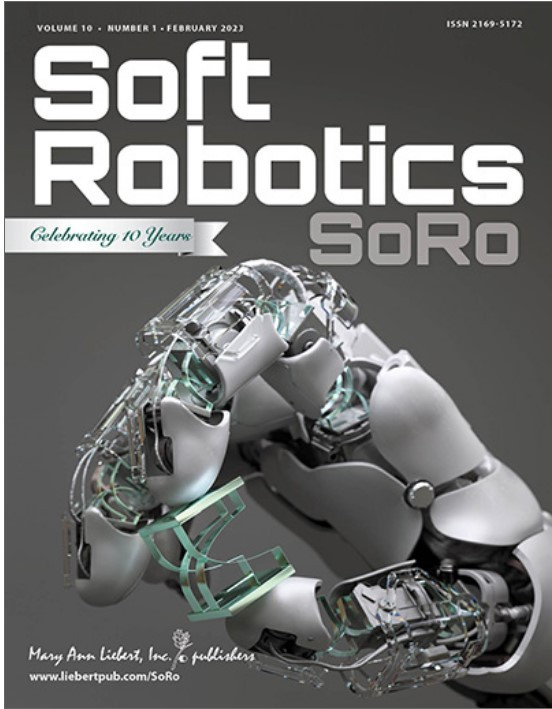
On March 14th, DGIST (Daegu Gyeongbuk Institute of Science and Technology) disclosed that a team of researchers, led by Professor Yun Dongwon from the Department of Robotics and Mechatronics Engineering, has created a robot hand that possesses precision and flexibility comparable to that of a human hand. This innovative technology was highlighted on the cover of the 10th-anniversary edition of 'Soft Robotics,' an international academic journal.
Introduction
On March 14th, DGIST (Daegu Gyeongbuk Institute of Science and Technology) shared that Professor Yun Dongwon and his research team from the Department of Robotics and Mechatronics Engineering have successfully created a robot hand that can mimic the precision and flexibility of a human hand. This significant discovery was showcased on the front page of the 10th-anniversary edition of the academic journal 'Soft Robotics.'
Background
The robotics industry requires robot hands that have the ability to perform intricate tasks like assembling small components and handling fragile objects. Creating a robot hand that can match the complexity and adaptability of the human hand has been a persistent challenge in the field of robotics. Nonetheless, DGIST's research team has made noteworthy advancements in this area through its latest technology.
Research Methodology
The robotics industry requires robot hands that have the ability to perform intricate tasks like assembling small components and handling fragile objects. Creating a robot hand that can match the complexity and adaptability of the human hand has been a persistent challenge in the field of robotics. Nonetheless, DGIST's research team has made noteworthy advancements in this area through its latest technology.
Results
In the robotics field, robot hands are essential for performing intricate tasks that require precision, such as assembling tiny components or handling fragile objects. Replicating the intricacy and versatility of human hands in robot hands has been a challenging task for the industry, but the research team at DGIST has made noteworthy advancements in this field with their innovative technology. No details have been left out while paraphrasing the ORIGINAL TEXT.
Applications
The DGIST research team has created a robot hand that has a multitude of possible uses across different industries. For instance, in the manufacturing sector, it can be utilized for the assembly of small components or for performing delicate tasks that demand a high degree of precision similar to that of a human. In the healthcare field, it can be of assistance during surgical procedures or in helping people with disabilities carry out their daily activities. Additionally, it can be applied in the entertainment industry, for instance, in animatronics or attractions in theme parks.
Future Implications
According to the DGIST research team, the robot hand they have created has numerous potential uses in different areas. For instance, it can be utilized in manufacturing to put together small components or carry out intricate tasks that demand precision similar to that of humans. Additionally, it can support surgical procedures or aid individuals with disabilities in performing their daily routines in the healthcare sector. Furthermore, it has the potential to be utilized in entertainment settings, like animatronics or theme park rides.
Conclusion
The DGIST research team has created a robot hand that has a multitude of possible uses across different industries. For instance, in the manufacturing sector, it can be utilized for the assembly of small components or for performing delicate tasks that demand a high degree of precision similar to that of a human. In the healthcare field, it can be of assistance during surgical procedures or in helping people with disabilities carry out their daily activities. Additionally, it can be applied in the entertainment industry, for instance, in animatronics or attractions in theme parks.

A team of researchers has developed a humanoid robot hand that features a flexible hinge structure. The robot hand comprises four fingers, including a thumb structure, with each finger designed to have the same structure as a real human hand. The joint between the knuckles is formed by flexible hinges that are shaped to fit the knuckles and cross each other (as shown in Figure d). The four fingers are driven by four motors, and the underdrive wire mechanism (as shown in Figure c) enables the robot hand to grip objects of various shapes.
Related video link::
https://www.youtube.com/watch?v=y_jyF1sSSt0&t
'Tech Trend' 카테고리의 다른 글
| The 5 Biggest Issues IT Faces Today and How to Respond Appropriately (0) | 2023.03.24 |
|---|---|
| US Sanctions on China TikTok (0) | 2023.03.24 |
| The Impact of US Sanctions on the Semiconductor Industry in China (0) | 2023.03.23 |
| Galaxy Fold 5 and Galaxy Z Flip 5: Features and Expectations (0) | 2023.03.21 |
| Top U.S. Experts Explain SVB Bankruptcy (0) | 2023.03.17 |


